
Campaign Management
How to Track Party Inventory, Gold, and Treasure in D&D
A reliable system for tracking who carries what, how loot gets split, and where the party's gold actually is between sessions.
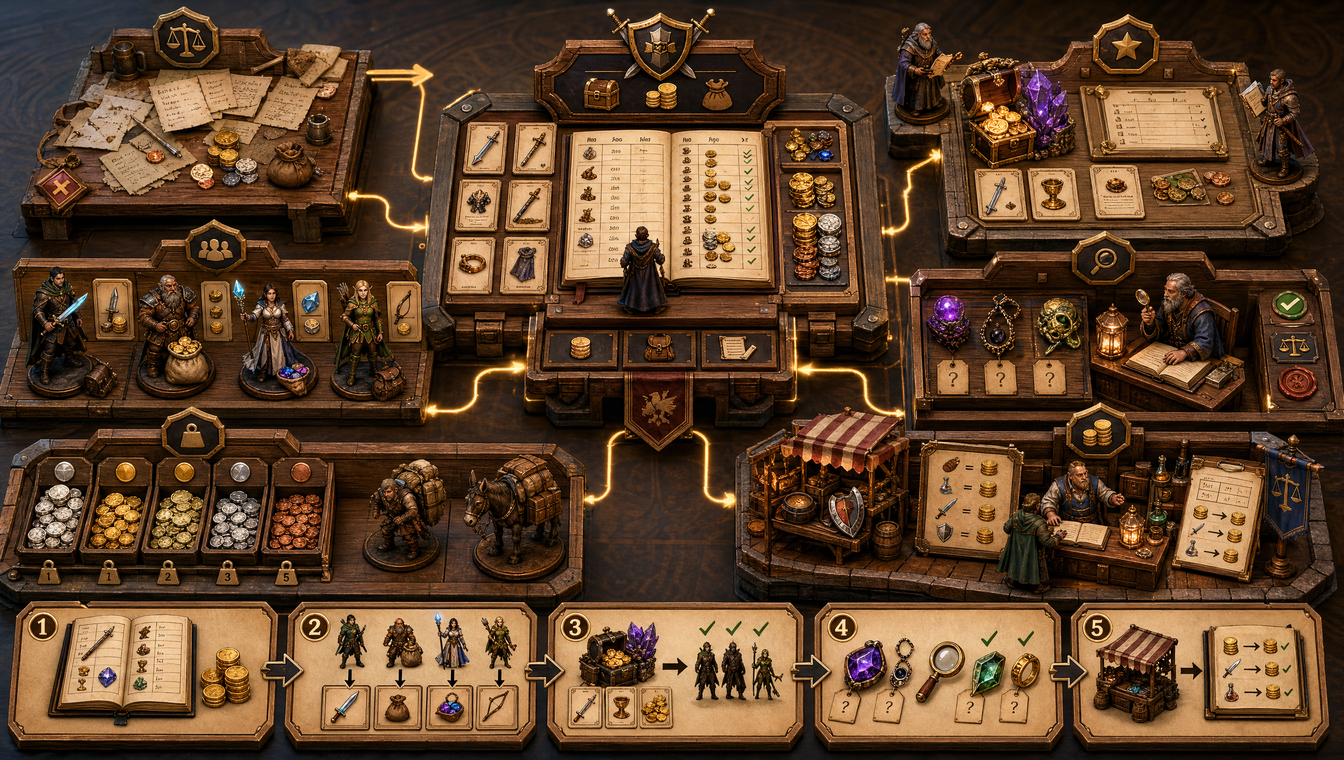
Ask three players who is carrying the magic dagger and you will often get three different answers. Inventory drift is one of the most common bookkeeping failures in a long campaign, and it compounds: uncertain gold totals lead to arguments at the shop, and forgotten items lead to retconned scenes.
A working system needs three properties: one authoritative record, updates at a consistent moment, and per-character ownership.
Keep one authoritative record
The party's wealth should live in exactly one place that everyone can see. Personal notes and chat messages are fine as scratch paper, but when they disagree, one record has to win. In Gold & XP, inventory and currency live on each character inside the shared campaign, so the authoritative answer is always the character record.
Track ownership per character, not per party
"The party has 4,000 gold" hides the information that matters: who is carrying it, and what happens if that character goes down or leaves. Track items and coins on the character actually holding them. Shared purchases still work — the group just decides which character is the custodian.
Update at one consistent moment
The best time to reconcile loot is when the session's rewards are finalized. Gold & XP handles this through session finalization: the Game Master records the session's spoils, and currency and items are distributed to the characters who received them. Because the update happens at a defined moment, nothing depends on someone remembering to edit a spreadsheet three days later.
Respect the denominations
If your table plays with platinum, gold, electrum, silver, and copper, track all five. Rounding everything to gold quietly changes treasure values and removes texture from old-school play, where hauling two thousand silver home is its own logistical problem. Weight and encumbrance tracking on each character keeps that problem honest.
Route valuations through the GM
Unidentified items and unappraised gems should not have a price until the Game Master gives them one. A simple approval step — the player asks, the GM answers — prevents the party from banking hypothetical value. Gold & XP builds this in: gem sale offers and item identification flow through Game Master approval requests.
Give buying a real place
Purchases feel better when they happen somewhere. Stocking shops and vendors at your campaign's locations turns "I buy rations" into a scene with a merchant, real prices, and a record of the transaction — and it gives gold somewhere to go, which keeps the economy of the campaign moving.
Want the bookkeeping handled for you? See the Gold & XP inventory and treasure tracker or create a free account.