
Worldbuilding
Organizing TTRPG Worldbuilding — Locations, NPCs, and Maps
How to structure a campaign setting so the details you invent at the table are still findable three months later.
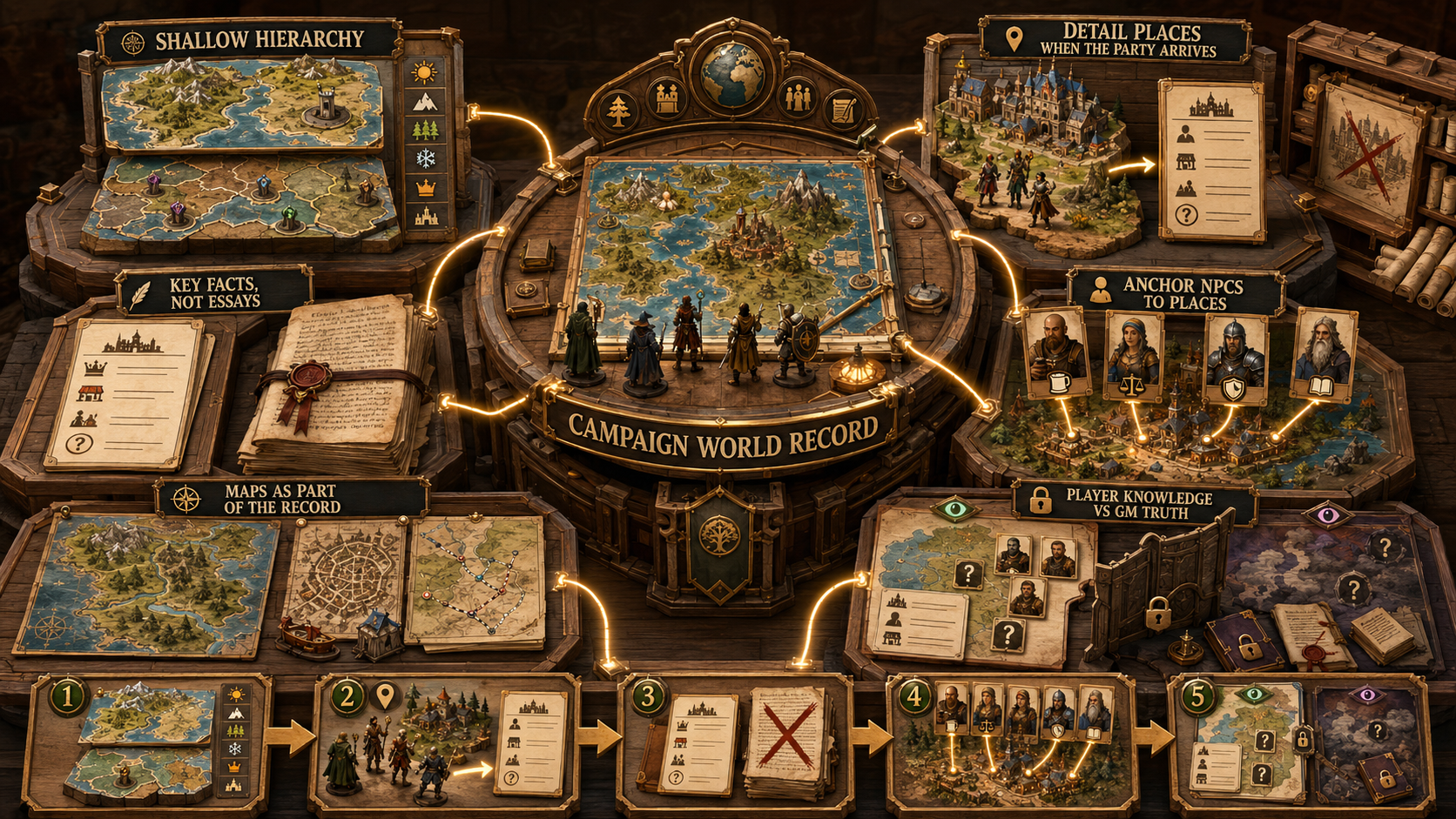
Most worldbuilding does not fail from lack of imagination. It fails from lack of retrieval: the tavern keeper's name is in a notebook somewhere, the map is a photo in a chat thread, and the region's politics live only in the Game Master's head. When the party returns to a place after three months, the world has quietly reset.
The fix is structure — a small amount of it, applied consistently.
Build a shallow hierarchy first
Give the setting a frame before filling in details: continents, countries, and regions, each with just enough character (climate, terrain, government) to make travel decisions meaningful. The frame does not need to be complete. It needs to exist, so every new place you invent has somewhere to live. Gold & XP models this hierarchy directly, with regions holding climate, terrain, government, and capital details.
Detail places only when the party arrives
Prewriting forty cities is how worldbuilding projects die. Instead, create a location record when the party actually reaches a city, town, village, or wilderness area, and capture only what the session revealed. A location that grows across visits is more consistent than one written in a single sitting anyway.
Use key facts, not essays
For each location, record the handful of facts the group will need again: who runs the place, what it sells, what the party did there, what is unresolved. Short, factual entries get read at the table; long lore documents do not. Gold & XP attaches key facts, vendors, transportation, and services to each location so the practical details stay next to the place.
Anchor NPCs to places
An NPC without a location is a name you will forget. Record NPCs where the party met them, with a role and a face — a portrait, even an AI-generated one, makes a character dramatically easier for players to remember than a name alone.
Make maps part of the record
A map communicates a region faster than any paragraph. Attach maps to the campaign and its locations so geography is something players look at, not something the GM re-describes each session.
Separate what players know from what is true
The party's knowledge of the world should differ from the Game Master's. Keep GM-only information private and reveal facts as characters earn them — a world with genuine unknowns is more interesting to explore, and players trust the shared record more when it only contains what they have actually learned.
Ready to give your setting a permanent home? Explore the Gold & XP worldbuilding tools or create a free account.